The endless battle between sports and politics
How the protest at Ulevål Stdium confronts the relationship between sports and politics
For many sports fans, watching a live event can be a great way to unplug from academic deadlines, work demands, and even horrible international crises.
Although politics may not be at the forefront of these sports fans’ minds, Hans Erik Næss, professor of sports management at Høyskolen Kristiania, underlines that the relationship is very much present and important.
– Sports and politics have always been intertwined. So whoever attempts to say otherwise simply doesn’t know a thing about history.
Large federations like FIFA and UEFA contain member states that have, and continue to, influence the decision-making process. Næss speaks of the challenge that comes with dealing with many countries in an international sports organisation.
– The internal politics of these organizations are as complex as dealing with international relations themselves
The neutrality issue
Sport federations tend to adopt a neutral stance on the politics of their member states. When asked about the topic, Næss lets out a small smile before explaining that these bodies have a lot to learn about neutrality.
– You see that in humanitarian organizations as well, but they have a much richer explanation of what it means to be neutral, and sports don't. They just say that they are neutral without considering the fact that there are many ways to be neutral.
Authoritarian regimes buy football clubs to promote and sports wash their own reputation
Looking historically at FIFA, they have worn the hats of a politically passive organization as well as an active one. Despite the former being more common, modern actions have created confusion amongst academics like Næss on whether the football federation stands by the principles of neutrality.
– Activism is never seen in the sporting world except for a very limited number of cases, like the apartheid regime in South Africa and now also partly with Russia.
The swift response taken by FIFA following Russia’s 2022 occupation and subsequent war in Ukraine was in line with the «FIFA statutes» – which, in article 3, underscores the federation’s strong commitment to human rights law. The FIFA Disciplinary Code was further used to suspend Russia from future competitions. But the ambiguity surrounding Israel’s continued membership in football tournaments has created uproar by interest organizations such as Palestinakomiteen.
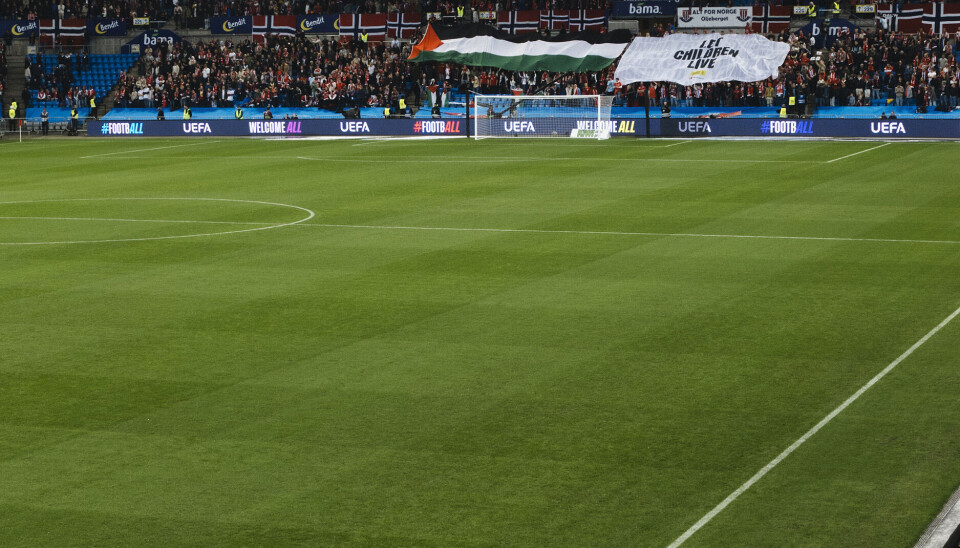
Protesting the 11th of October Israel-Norway football match
Line Khateeb is the current leader of Palestinakomiteen – the group responsible for the protests at Ullevål Stadium during the football game between Norway and Israel in October.
The protest resulted in the arrests of 22 protestors, which attracted international attention, as Khateeb says:.
I really wish we could have leaders who would dare to say that we follow our own guidelines and FIFA guidelines.
– I think I was called by 10 to 15 different international media outlets when we had the demonstration related to the game.

The large media response after the protest shows that political confrontations in sports are on the rise. When asked the question on the relationship between sports and politics, Khateeb provides a similar response to Næss.
– When there are international tournaments, it becomes political. We also see that authoritarian regimes buy football clubs to promote and sports wash their own reputation
She hopes the protest managed to confront people with the reality of sports and politics.
– We wanted to reach the people going to the match who didn't really think much about who Norway was playing against or why it was important to be aware of it. Accepting to play a team representing a state committing a genocide is not something that should go or pass unnoticed.
Looking at the Norwegian Football Federation (NFF) and FIFA
The NFF is Norway’s authority body for football, and it’s currently led by Lise Klaveness. Næss believes that larger federations can learn from the NFF’s approach to the social and political demands of modern-day football.
– The pros of their strategies are that nobody misunderstands what they are favoring or what they are supporting. And that's actually quite rare in the sporting world at this level.
Khateeb and Palestinakomiteen also commend NFF on their willingness to discuss Palestine’s access to opportunities in football.
Sports and politics have always been intertwined
– They've been open to meeting us and discussing, and they have good relations with the Palestinian Football Association because Norway has been working with them for a while.
However, transplanting the NFF’s transparency to FIFA is quite difficult because of the rigid structure of the latter, which Næss believes can be attributed to member state bureaucracy.
– In terms of making structural changes to FIFA, it's a hot switch of what should be the administrative responsibility and what should be the responsibility of the member states.
The difficulty in differentiating between responsibilities is most apparent when political issues arise, as Næss points out that it is both an internal affair of the member state involved and invokes FIFA's human rights guidelines.
Hopes for the future of sports
When asked about the changes he wants to see in the future for sports, Næss makes it clear that leaders of federations must re-evaluate their response to the political conflicts of member states.
– Federation leaders must be clear about what they mean and be transparent about what the organization can do based on a position that's comprehensible to everybody.
When international sports organizations hesitate to respond to violations of their guidelines or fail to act consistently, it gives room for member states to further threaten the rules-based order. In a world where international law can be broadly interpreted by state-leaders in organizations like the UN, it’s important that the guidelines set by sports federations are less open-ended.

Khateeb's hopes are focused on large international sports bodies, like FIFA, and domestic leaderships staying true to their principles and placing sanctions when international law is violated, even if they claim to be apolitical.
– I really wish we could have leaders who would dare to say that we follow our own guidelines and FIFA guidelines.
Norway’s qualification to the 2026 World Cup
Norway’s triumphant 4-1 victory over Italy in Milan on Sunday marked the country’s first qualification for the World Cup since 1998. The biggest football tournament in the world is to be played in North-America next summer, with 11 stadium agreements settled in the US by FIFA, according to the New York Times.
Despite being owned and operated independently by FIFA, Donald Trump has made comments about moving World Cup host cities that fail to cooperate with the administration’s crime and immigration initiatives, most of which are run by Democratic mayors.
The New York Times stated further that Trump would call the head of FIFA, Gianni Infantino, to make the changes if necessary. It now remains to be seen if FIFA will abide by its independence, or whether they will budge for politicians like Trump.
The response of national federations like NFF to the politicization of the World Cup will be interesting to see, especially if Trump is successful in pressuring FIFA to relocate host cities away from democrat-majority cities.